
Wading In Still Waters
Four provocations of art
Introduction
This research project came about through a conversation with Jill Howitt, who offered me the opportunity to explore a short body of research related to Hull and its location near the water. I began writing it in late March, just as the winter frost had begun to lift and the last of the icy patches that lingered on muddy paths were melting back into puddles. Two months down the line, I was exhausted. I had taken on a new job, moved house, and had strayed away from writing. I was avoiding the pages you are about to read; in a moment of poetic irony, I was drowning.
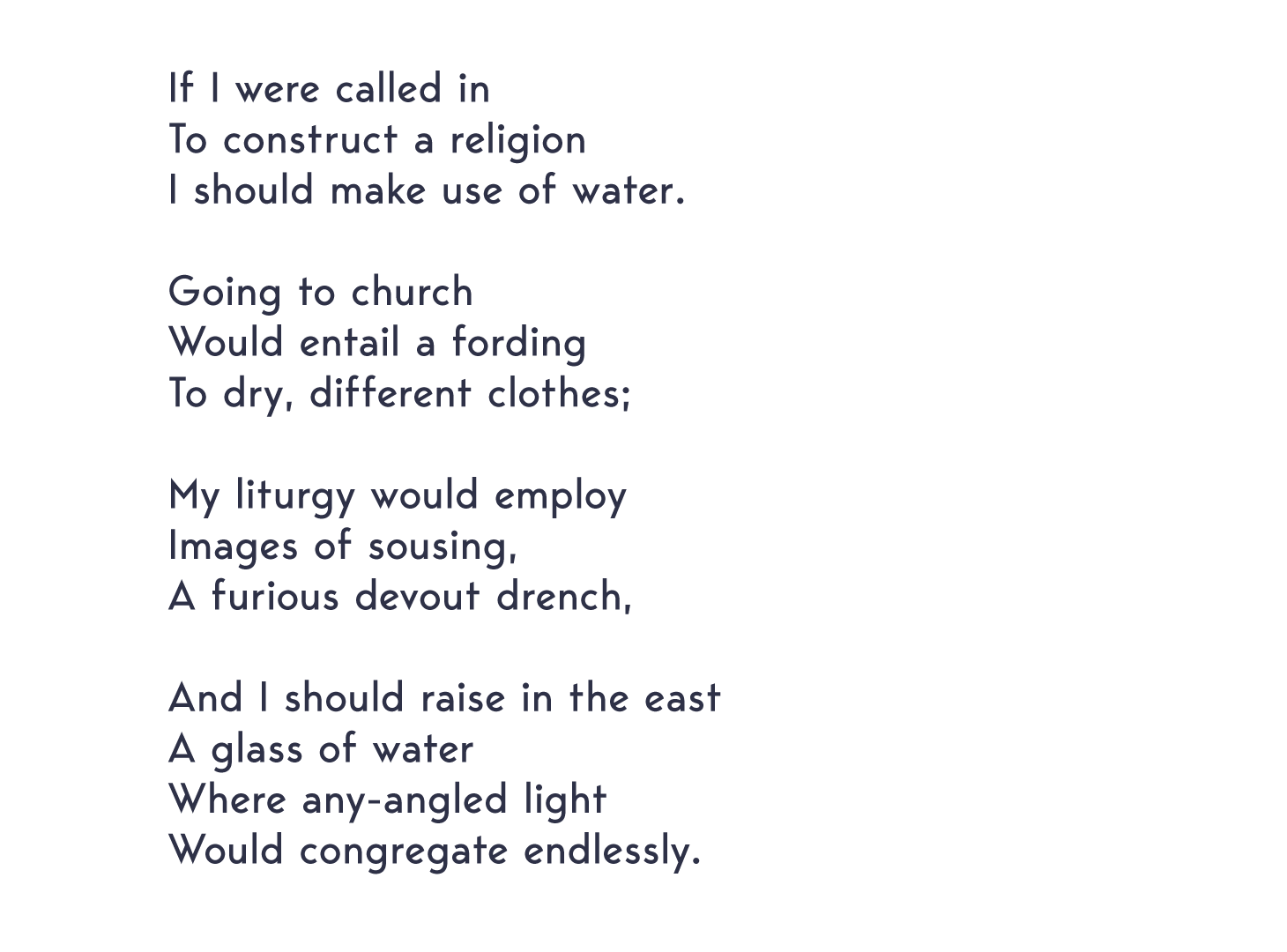
As a newly confirmed citizen of Hull, Larkin was the foundation upon which my limited knowledge of this city’s cultural exports was rooted. It only felt fitting, then, that he marks the tributary through which the river that flows downstream – downpage – is fed. Through a rereading of his poem Water, replacing his focus on religion with one of water, I attempt to emerge at the end with a new message.
At the time of writing, Humber Street Gallery was showing the INTER_CHANGE showcase, a group show of works made by early career artists. Three reflections on works taken from this exhibition make up the largest chunk of my writing. They’re brief, reflexive, experiential pieces that gravitate towards a number of ideas but never fully commit themselves to landing on their surface. Like puddles, they are compact; like rivers, they undulate; like the sea, they’re vast in concept.
[RE] [DE] Constructing Larkin’s ‘Water’
Taking the I from the poem is an attempt to extract Larkin himself from the text, leaving only nature’s presence to hold up the fixture of writing. To remove the I is to remove the power of self, and to leave the power of nature in place. To ‘construct a religion’ is to simply ‘construct’; a ‘glass of water’ is only the glass, and what is held within is indeterminate.
Hull sits precariously on the banks of the River Humber, both a site of rich habitat and at-risk ecosystems. The coastline here is second only to London in terms of the dangers faced by flooding. Larkin wouldn’t have known that when he wrote this poem.
Through subtracting words I embark upon an excavation of the text, an attempt to draw new meaning from old words. Eventually we are left with only four.


Raelle Marshall
Suspended from the ceiling of the white-walled gallery is Raelle Marshall’s work. There is no name attached to it, simply a piece of text that tells us the thinking behind her practice: climate change, location, migration, colonialism, water. Spreading out like a fan at the top and slinking down to the floor, the reused and recycled textile hangs patiently in the corner of the room.
The creases in the fabric produce waves. Ripples that swim in and out of view, hiding behind each other, lying in wait for someone to walk by and notice them. A faded print sits buried within the cloth, shaded marks impressed upon the surface of the material resemble the outlines of buildings from which smoke stacks, waves, and debris rise. These marks are loose and disparate; they do not claim a home on the cloth, instead they are suspended in it.
Travel upwards, or upstream, and you’re met with a blockade. As beavers build dams in streams, Marshall has built an impasse in her work through the jute string which brings together the fabric into one tense location. See, location is important in her work. Marshall creates on the other side of the country in Liverpool; her work is here temporarily, part of an exhibition at Humber Street Gallery. When you read this, it might not be here anymore, though we can assume that it might still exist somewhere.
There’s a story waiting to be read in the pages of Marshall’s work. Unravel the string slowly and a flood will crash down on you.
Pheobe riley Law
‘OH O SALINITY’ feels like a cry for help, a call to action, and a despairing sigh all rolled into one. Equal part film, sculpture, and installation, Phoebe riley Law’s deconstruction of natural materials and science is a cathartic exploration into the importance of salt in our eco systems.
A large three-tiered metal table becomes the site of Law’s experiment suspended in animation; a bundle of sticks and branches fill the middle shelf, whilst the mounds of salt that are collected on the other two shelves appear to be waiting for that flood of water to dissolve them.
Salinity is defined as the total weight of dissolved salts in one kilogram of seawater. Here, water is absent; instead, Law displays her circular mounds of salt alone, varying the coarseness and the size of each mound and creating what appear as monuments to one of the earth’s most natural resources.
Law accompanies the installation with a small colour-printed zine. Full of rich, vibrant stills from the film on display, a transcript of the text we read on screen flows like verse through the pages of the book.
‘we sing salt/ we speak salt/ we ritualise salt’
Through ‘OH O SALINITY’, Law sings and speaks her message to us. Delicate piles of materials laid out on the table invite us into a ritual dedicated to the process of salinisation, a ritual embedded deeply in earthliness and scientific experimentation.
Luke Beech
Take a breath; in, and then out. Slowly. Make sure you breathe deeply on the exhale, exalting your demons in one fluid, charged motion.
In Beech’s video Bator, the fishing hook becomes the fixture that we attach our innermost desires and thoughts to, casting them out across the stillness of the lake in a swift and heavy heave. Beech, lying recumbent, half of the screen his body and the other half a dangling hook, breathes deeply over and over. Look once, and the hook is fixed onto his lip; look again, and it’s swinging away from him, cast out by his deep repeated sighs.
Dogger Bank gave way to the Barents Sea; fisheries of fishermen fishing for fish. Hull, once a proud fishing port, has been cast into the history books as what was rather than what is. The fishing hook is now erotica. The fishing hook has been transformed, snatched away from its functional use and appropriated for art.
Sitting in front of Bator I become transfixed, cast under the artist’s spell as if he were swinging a pocket watch in front of my face and lulling me to sleep. Beech, recumbent, pays no mind to the viewer on the other side of the screen. He is certain that we are still there, his mind only concerned with the fishing hook that dangles in front of him.
Afterword
We’ve now reached the early months of summer; June is the place I sit whilst I type up these final words. The INTER_CHANGE showcase exhibition has come and it has passed, a cycle that promises to repeat itself across institutions up and down the country and across the world.
I’ve been thinking about Barthes’ système de la mode by way of Pablo Helguera’s thoughts on the cyclical nature of art; that we are ruled by the clock much in the same way fashion is, only we do not label our exhibition seasons as the Spring/Summer or Autumn/Winter collection. Nonetheless, we are more than willing to continually replace old ideas with new ones without allowing ourselves and our audiences time to digest or to think about what it is they have seen.
In writing this work, part of my intention has been to put to memory the works that inhabited the gallery space and test them against their own temporality. Will they remain relevant when I type the last word on this page? Will their power still be felt long after they are removed from view? Is it simply enough to have existed? Or, do we require art to remain available, visible and, again, relevant? I’ll sit with that thought for a while.
Rain falls more sporadically now, and will continue to do so for the next three months until the seasons cycle back towards shorter days and longer nights. I intend to make the most of being outside, touching and feeling nature, dipping my toes in the oceans and rivers, and spending less time holed up inside galleries and museums. Art is found everywhere; it is felt everywhere, and I feel the need to embrace that.
When the rain returns, I will seek shelter again.
Read more ‘Above Below…’ articles:

Seaing Monsters
by Lee Karen Stow A photographic response to the influence of newspaper reports of sightings of sea monsters on the Yorkshire Coast and river Humber. People see what they want to see. I see monsters in the seaweed.“… in addition to its great height, the serpent had...

Interchange
Words: Jill HowittThis article is about the new mural, ‘The Creation of Hull’, in the Ferensway entrance to Hull Paragon Interchange which was ‘unveiled’ in November 2023. TransPennine Express (TPE) commissioned local Hull artist Andy Pea to produce the artwork as...

Hull’s Whaling Heritage Through Sewing and Song: An interview with artist Caroline Hack
In April Hull Maritime launches a new series of pop-up exhibitions with A-Fishing for the Whale by artist Caroline Hack. The exhibition features three textile works, which are on display from 12-26 April 2023 in Princes Quay Shopping Centre, and a newly commissioned work-in-progress piece inspired by Hull’s folk music heritage, on display at a film screening and meet-the-artist event at Ferens Art Gallery on Wednesday 19 April 2023.
In this interview, Hull Maritime’s Charlotte Tomlinson sits downs with Caroline Hack to talk about commissioning the exhibition, learn more about the works on display, and explore Hack’s connection to Hull’s maritime past and present.