
Words: Caroline Hack and Charlotte Tomlinson
Hull’s Whaling Heritage Through Sewing and Song: An interview with artist Caroline Hack
In April Hull Maritime launches a new series of pop-up exhibitions with A-Fishing for the Whale by artist Caroline Hack. The exhibition features three textile works, which are on display from 12-26 April 2023 in Princes Quay Shopping Centre, and a newly commissioned work-in-progress piece inspired by Hull’s folk music heritage, on display at a film screening and meet-the-artist event at Ferens Art Gallery on Wednesday 19 April 2023.
In this interview, Hull Maritime’s Charlotte Tomlinson sits downs with Caroline Hack to talk about commissioning the exhibition, learn more about the works on display, and explore Hack’s connection to Hull’s maritime past and present.
Book a place for the artist talk and film screening of Travelling for a Living (1966) here.
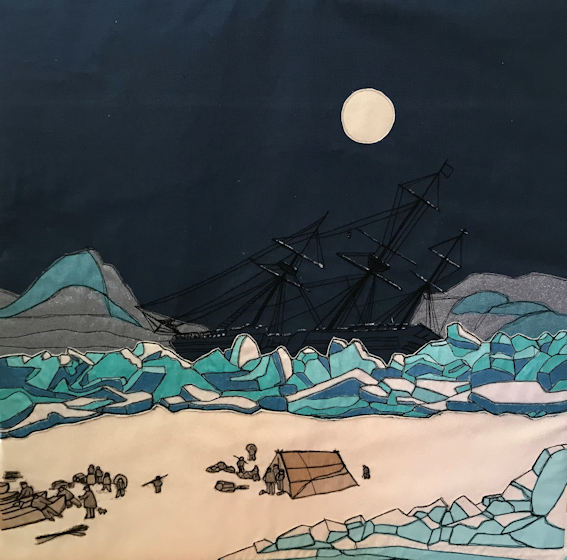
Beset by Caroline Hack
CT: At Hull Maritime we’re really excited for the launch of A-Fishing for the Whale. Can you tell us a bit more about the inspiration and story behind the works.
CH: The three textile pieces that are on display in Princes Quay are part of a cycle of works I made for myArctic Whaling Year exhibition in Dundee in 2018. Stoved! and Beset are about the hazards of whaling, a whaleboat getting hit by a whale tail (as described in the Greenland Whale Fishery song) or getting trapped in the ice and being forced to over winter (as happened to the Hull whaler the Diana in 1866-7). The central work The Whaling Grounds pulls together a range of images. The map is from an account of a whaling voyage by John Laing, a surgeon who sailed with the famous whaling captain William Scoresby of Whitby in 1806. The quilted right whale is based on an illustration from Scoresby’s 1820 book An Account of the Arctic Regions. The ships and polar bear are based on one of the whaling paintings from Hull Maritime Museum. In the whaling scene I have added some icebergs based on sketches I made in Greenland in 2014 and the coastline is from one of the bays in Spitsbergen I visited in 2012.
CT: Each of the pieces in the exhibition are very striking, they have a real richness both in terms of the stories they tell and as works in their own right. What does the process of making one of these pieces look like?
CH: Somewhat chaotic if I’m honest! The part that takes the longest is generally coming up with the idea, content and layout. Fortunately as I now have a very large collection of drawings, notes and photographs I can pull together things I want to include. I make simple ink line drawings, scan them, combine them either digitally, or with scissors and tape to get a composition that works. The bigger pieces are often made in sections and I have to carefully plan how the sections will go together, ensuring I have a little flexibility because things never go quite to plan.
I work with a relatively restricted selection of base fabrics and techniques, so typically I scale up the final drawings, using a light box trace them onto the base fabric (often a plain undyed calico cotton). If there is going to be any fabric painting, that comes next. Quilted pieces (like the whale) are added at a suitable stage and then layered coloured organzas are sewn on using freehand machine embroidery and lots of pins. I use a fine tipped soldering iron to trim excess organza. This gives a very clean line and secures it. I have to be very careful when burning one layer above another not to accidentally burn the next layer, or myself! When the pieces are finished the next task is to sew them together. This is always the most exciting part as you never know quite how they will look together, particularly as I don’t do colour studies and work from a black and white drawing. It’s always rather magical when I hang the completed piece up for the first time and see what I’ve made.
CT: As well as exhibiting existing works, A-Fishing for the Whale also includes an exciting new work-in-progress which will be on display during your artist talk at the Ferens on 19 April. What can you tell readers about that?
CH: The new work is inspired by the traditional whaling song The Greenland Whale Fishery. It fairly accurately describes Arctic whaling but is a great example of the fluidity of these traditional songs with a range of tunes and lyrics. I’ve made small works about it before but I wanted to attempt something larger.
At the moment I am in the development phase, working out the layout. I’ve found a suitable map from 1865, and have drawings to add to this. I want to incorporate the lyrics for The Greenland Whale Fishery somehow, and have taken a bit of time looking at the range of different verses in the many different version of the song and have edited them to a single short version.
CT: We’ve described the exhibition as exploring whaling heritage through sewing and song – can you tell us more about folk music and how that plays a part in your work?
CH: For a time when you entered the whaling gallery in the maritime museum it set off a recording of the Hull folk group the Spare Hands singing The Gallant Volunteer, their version of the Bonny Ship the Diamond. When I play the song (I bought a copy of the CD from the Maritime Museum gift shop) I am immediately transported back to the gallery, with the Truelove flag on my right and the seat made of whale bone straight ahead.
Killing whales is now seen as a barbarous and unnecessary industry, but in the past it provided economic benefits to the ports like Hull involved in whaling, investment opportunities and a pool of trained sailors to be called upon in times of war. Whaling songs are one of the existing aspects of whaling that people can enjoy today. They give a flavour of the industry (these are often work songs with particular rhythms to help coordinate labour). They also describe the good and bad times of this tough but adventurous life.

Whaling Grounds by Caroline Hack

Stoved by Caroline Hack
CT: Your own practice is pretty adventurous too – you’re based in Norfolk and have travelled to destinations around the world as part of your artistic practice. What’s your relationship to Hull and what does the city mean to you?
CH: I first visited Hull in 2010 on my way back from Whitby. For the previous decade much of my art practice had been around Melville’s epic whaling classic Moby-Dick and both Hull and Whitby Whaler William Scoresby Jnr are mentioned in that book:
There is a Leviathanic Museum, they tell me, in Hull, England, one of the whaling ports of that country, where they have some fine specimens of fin-backs and other whales.
I was delighted with the whaling gallery at the beautiful architectural gem that is the Maritime Museum, took loads of photos and promised myself a longer visit next time. I’ve been a regular visitor ever since. I’ve worked in museums and I was blown away by the museums and galleries here in Hull – the quality, breadth of the collections and the free entry.
The collections of Hull Maritime Museum have been a source of inspiration for a range of works I’ve made, from handmade books to large textile panels. The joke razor, the tridents on the railings outside, the picture of the Truelove on the ceramic plate, the polar bear skull, even a pattern on a border of a summary of a year’s whaling. I’ve had a few works accepted for the Ferens Open too.
I was absolutely overjoyed when Hull was awarded City of Culture because I knew they deserved it, and was thrilled when they rose to the challenge and produced a magical year full of surprises (who but Hull could install a wind turbine blade in the main square?) and I even played my own small part as one of the 3200 who participated in Sea of Hull.
But aside from the culture, it’s the people that make Hull. I can’t think of another place where the people are so welcoming, chatty, are pleased to see you visiting their city. The lady in the chip shop, hotel staff, other customers in coffee shops. I always get chatting to people.
CT: Absolutely, I couldn’t agree more. What’s one thing you’d really like people to take away from this exhibition?
CH: Hull has a fabulous maritime heritage that is and should be celebrated and the Maritime Museum is the jewel in that crown and I hope that they are as excited as I am for the reopening!
A-Fishing for the Whale goes on display at Princes Quay Shopping Centre (Monument Bridge entrance, next to Millie’s Cookies) from 12-26 April. Caroline Hack’s artist talk, and a screening of 1966 documentary film Travelling for a Living, will take place on 19 April at Ferens Art Gallery. Tickets available here.
With thanks to BFI National TV Archive and Charismatic Encounters.
Read more ‘Above Below…’ articles:

Seaing Monsters
by Lee Karen Stow A photographic response to the influence of newspaper reports of sightings of sea monsters on the Yorkshire Coast and river Humber. People see what they want to see. I see monsters in the seaweed.“… in addition to its great height, the serpent had...

Interchange
Words: Jill HowittThis article is about the new mural, ‘The Creation of Hull’, in the Ferensway entrance to Hull Paragon Interchange which was ‘unveiled’ in November 2023. TransPennine Express (TPE) commissioned local Hull artist Andy Pea to produce the artwork as...

My Journey in Paint: A retrospective exhibition of paintings by Ian Humphreys
In September 2022 Ian Humphreys had a retrospective exhibition of his paintings at Kenmare Butter Market in Co Kerry. This short essay was written for the exhibition catalogue. Welcome to Ian Humphreys’ retrospective exhibition which he describes as celebration. The...