
Interchange
This article is about the new mural, ‘The Creation of Hull’, in the Ferensway entrance to Hull Paragon Interchange which was ‘unveiled’ in November 2023.
TransPennine Express (TPE) commissioned local Hull artist Andy Pea to produce the artwork as part of their 175-year anniversary celebrations – and Andy consulted with the public to find out what they would like incorporated into the design – which historical events and figures would station users and local residents want commemorated in the new mural celebration of Hull.
I’m writing this with two overlapping hats on – cultural and environmental. I have a longstanding passion for public art (particularly in Hull). I am interested in what defines public art and as a newish member of Hull Friends of the Earth (HFOE), I’m drawn to the intersection between art and climate/environmental crisis – and the question of what art can do in these challenging times. I am also a great fan of public rather than private transport – in a world where a quarter of CO2 emissions are caused by transport, I believe that bus and train travel (as well as bikes and walking) should be prioritized over individual car use. I often catch the bus or train and was intrigued to see the mural unfold alongside the notion that a revitalised Interchange could boost public transport use and become a destination in its own right. I am very grateful to Benjamin Courtney (Station Manager) and Andy Pea for talking to me and sharing their perspectives. In this writing, I travel between cultural and environmental contexts connected by the word ‘public’. What makes art or transport public – who uses, makes, owns, decides about, and benefits from them? And does this include past, present, and future publics?
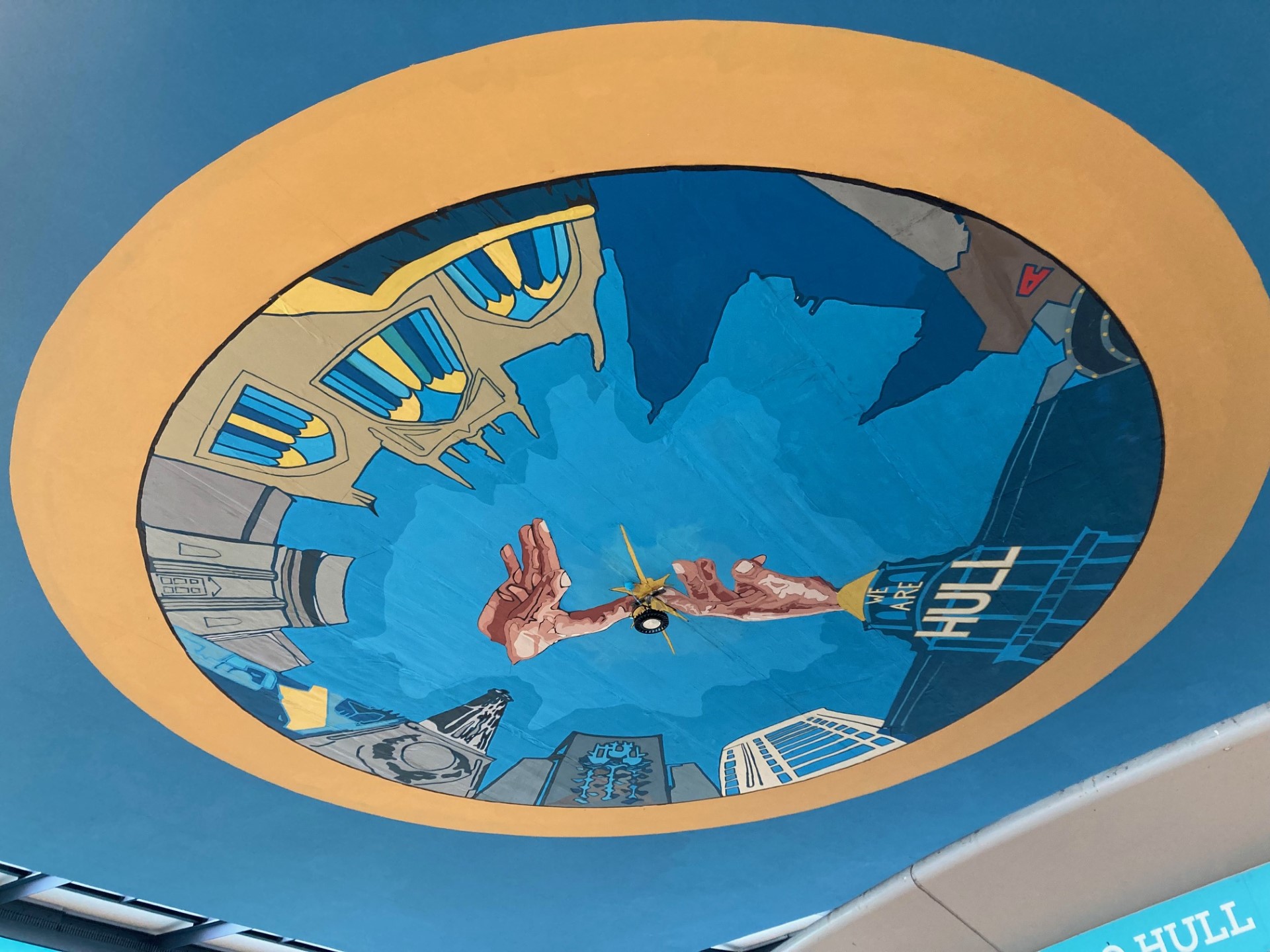
When I say the mural was ‘unveiled’ there was, of course, no final reveal. All the early stages, the underpainting, the sketched lines and marks were visible – giving the public a unique insight into the process. For me this created anticipation and drama, and early on I wondered about the connection with Michelangelo’s painting in the Sistine Chapel. This wasn’t confirmed until the very end when the image of two index fingers touching appeared on the Station ceiling, referencing the fingers of God and Adam and the creation story painted on the Chapel ceiling. And it was this incongruity that really caught my imagination. Hull and Rome, Paragon Interchange and the Sistine Chapel, Andy Pea and Michelangelo – why not?

It was these kinds of questions about ‘great’ art in ‘ordinary’ places that originally drove my research into public art. I have come across the proposition that prestigious art isn’t appropriate for public spaces. Such mapping makes me cross – I like artworks on housing estates, in stations, outside football grounds that challenge class and geography hierarchies. (Andy also describes working in public spaces as an honour). Conventionally public art celebrates place identity and heritage (often industrial) and is bound up with urban regeneration. Conversely, I’m interested in public art that highlights endangered places and species in the context of nature recovery and environmental crisis. This is particularly important in Hull with its vulnerability to flooding and the eroding coastline nearby.
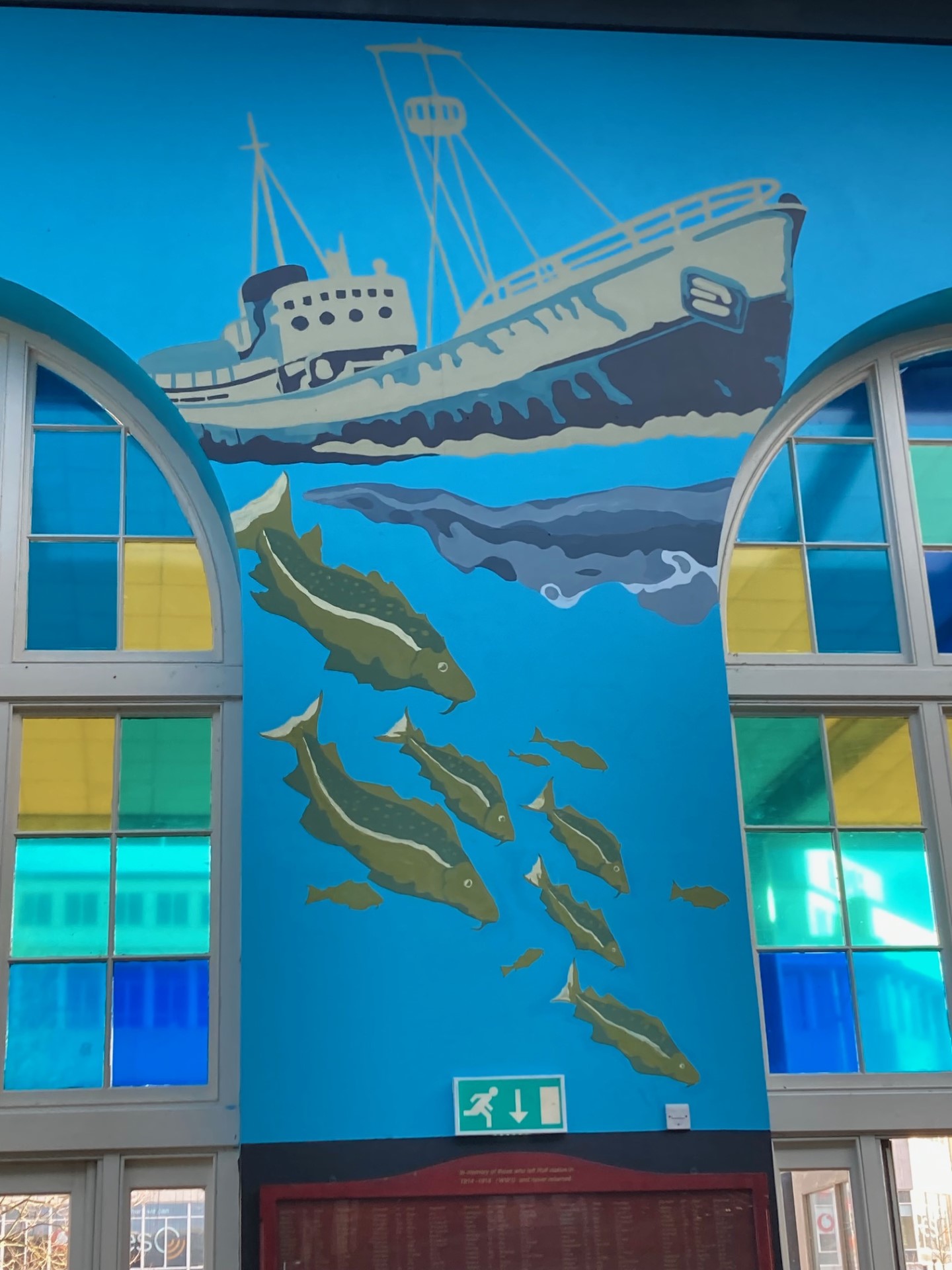
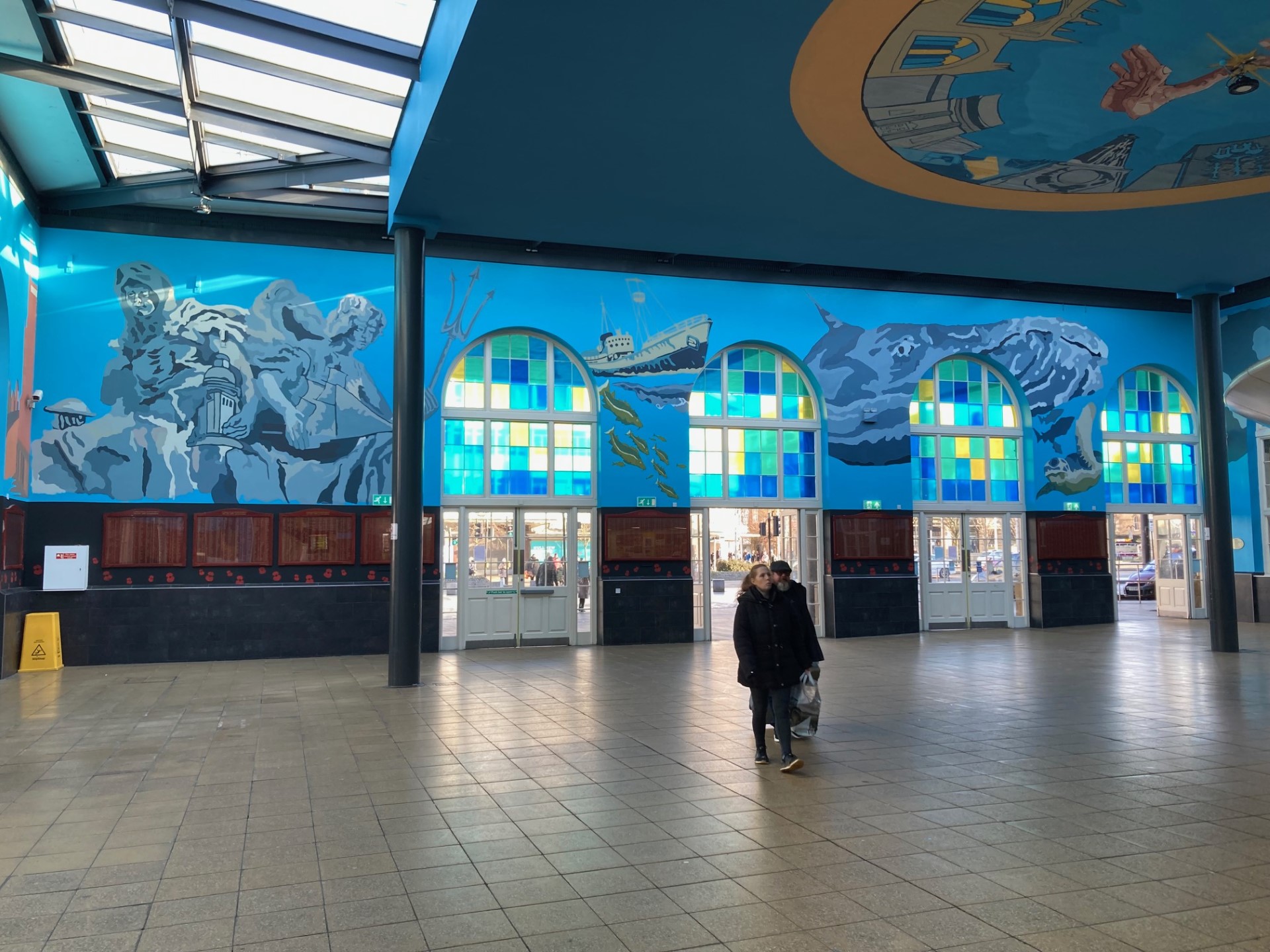
‘The Creation of Hull’ covers the four walls (broken up by windows and doorways) of the entrance space and this ‘all roundness’ extends above the viewer’s head. It is a different viewing experience from standing facing a mural on a flat wall. This reminds me of being surrounded by light projections on the buildings round Queen Victoria Square during the opening City of Culture ceremony in 2017. People arriving, departing or passing through encounter the Interchange mural as they crisscross the space catching details of trains, trawler ships, fish and whales, iconic Hull buildings, memorials to those who died in the world wars or at sea, wildlife, a black and amber scarf, three ships and three crowns, and the outline of a toad – a reference to poet Philip Larkin whose statue stands about 200 metres away on the station concourse.
The painting style references the familiar brightly coloured railway posters from the 1930s, and Andy cites influences from mural artists such as Diego Riviera and artists who worked on Federal Arts Projects during the Great Depression as part of Roosevelt’s ‘New Deal’ in 1930’s America. I like that Andy has included images of fish and birds that represent the unique habitats of the Humber Estuary which are as (or more) important to the identity of Hull as historical figures, events, and the man-made environment.
I haven’t been to Rome or visited The Vatican or The Sistine Chapel although I have seen an exhibition of high-resolution photographs in Hull Minster in October 2019. These show visitors similarly surrounded by images on walls and ceilings of bible stories, including ‘The Resurrection’, ‘The Creation’, and ‘The Last Judgement’. In contrast, though, they will have chosen and paid to see the frescos and been directed round the space in an organized way. Michelangelo’s ‘The Last Judgement’ covers the altar wall of the Chapel with over 300 figures – many ascending or descending to heaven or hell according to Christ’s judgement. This complex detail is set against and connected by the backdrop of blue sky. All the details of buildings, trains, ships, birds, fish, whales, and people in ‘The Creation of Hull’ are similarly brought together by a blue background.
It was this distinctive use of blue that initially alerted me to The Sistine Chapel connection. The repeated blue on walls and ceiling also transforms and unites the entrance space – from a disjointed thoroughfare to a particular space of its own. Two sides have large glass arched doorways – opening out onto Ferensway and the crossing to St. Stephen’s shopping centre. The third has arched openings onto the station concourse. This creates an extraordinarily open and light space with long vistas and views from one space to another – interior against exterior. The mural appears differently according to time of day and weather. Natural light floods in and illuminates and complicates the painted representations of light and shadow. In certain lights the blue looks luminous and unexpected and can be glimpsed from the far end of the bus bays. This is enhanced by the blue, yellow and green stained-glass windows which form part of the design.
Blue recalls the sky, rivers, sea, and the relationship the city has with water. Blue also links to some of Andy’s other murals in Hull such as ‘The Girl’, 2020 (Andy worked alongside Calvin Innes), and ‘The Boy’, 2021. These were ‘Shorelines’ projects and depict rising sea levels and flooding, as experienced by future generations. Both are almost entirely in tones of blue except for a red balloon, some colourful drawings and a beach ball. These are on the Queens Gardens Hull College building and Clumber Street respectively. In addition, not far from the station, is ‘The Headscarf Revolutionaries’ (2016) also painted by Andy alongside Kev Largey, Mark Ervine, and Sharon Darley, featuring Lillian Bilocca and commemorating The Triple Trawler Tragedy (1968). The mural, also saturated with blues, is on the end of Goodwin Community College, on Anlaby and Pease Roads.
Blue has other significant local and art historical connotations. Hull is associated with Reckitt’s Blue, a traditional bluing agent used in laundry manufactured by Reckitt which started in Hull, and who have a factory in the city. The city is further connected to blue via the ‘Sea of Hull’ photographs taken by Spencer Tunick in 2016. These featured around 3,200 volunteers who removed their clothes and painted their bodies one of four different shades of blue, before being photographed in strategic sites around the city. Historically, blues such as ultramarine and indigo have been the most precious and expensive pigments, often reserved for the most prestigious parts of a painting such as depictions of the Virgin Mary. Moreover, blue is also connected to specific artists – such as Picasso, Matisse, Miro, and Yves Klein, and associated with sadness and spirituality. ‘Blue murals’ such as ‘The Creation of Hull’, and others in the city, represent the big skies and intertidal ecosystems of the coast and estuary. They are windows onto the city’s relationship with water over time – the history of the docks and the fishing industry, and a future dependent on our ability and willingness to respond to climate emergency.
When I spoke to Ben Courtney, he also described being drawn to the blue of the mural. Ben became station manager in 2022 and explained how he walked the station on a daily basis and noted how it was ‘in need of some love’. He wanted to commission a contemporary work that would also be a tribute to the city. The process was community-oriented, involving interviews with Interchange users and Andy worked with students from Ron Dearing UTC. Ben also suggests that the Interchange could be the start and end point for city art tours. We talked about the Interchange becoming a destination in its own right – a place to visit and a focus for civic pride. The mural is part of a wider vision including increasing safety at the Interchange. To this end a new Well Being Hub has opened in an empty shop space on the concourse. The Hub is used by Transport Police and different local charities and is a ‘point of contact’ for vulnerable rail and bus users. Hull Samaritans’ Director Tony Rheinberg describes the Hub is an important location for Samaritans’ outreach – ‘we find it a central and accessible venue to engage with a broad range of people’. There are also plans to convert the historic ticket office (adjacent to the mural) into a pub and to extend the station by reinstating platform 1. This has huge historical significance as between 1836 and 1914 more than 2 million transmigrants – many fleeing persecution from Northern/Eastern Europe – left Hull for Liverpool and beyond to America. Both these developments could include an art dimension.

Ben is hugely committed to improving the Interchange as a transport Hub, a social and cultural space, and as a desirable destination. We talked about how this could encourage public transport use and lead to improvements in the line. We also discussed environmental impacts and plans for energy conservation, solar panels, and recycling measures. It strikes me that bus and train stations, and Interchanges are also implicitly green (blue?) Hubs – they provide an alternative to road transport which contributes to 10% of all global CO2 emissions. Conversely, a Department of Transport study reports: ‘In 2019, greenhouse gas emissions from rail made up just 1.4% of the UK’s domestic transport emissions’, and ‘on average, rail freight trains emit around a quarter of the CO2 equivalent (CO2e) emissions of HGVs, per tonne mile travelled’. I’m no expert on these kinds of statistics and there is more to be done (and is being done) towards sustainability regarding public transport/sites and strategies: decarbonisation, improved air quality, free and subsidised fare policies, water use and waste water disposal, and optimising bio diversity and integrated transport systems. However, spending time at Paragon Interchange, talking to Ben and Andy, watching the mural evolve, helping out at the Hub, made me think about interconnection. The fluidity of cultural, social, and environmental (public) goods and how they support each other.
It’s like its own little community or ecosystem – where a mural ignites the imagination, raises issues, and becomes a place to visit (via train or bus). A sense of community was central to my conversations with Ben and Andy. It was lovely to hear Andy describe the community and collaborative aspects of the project and his conviction in the role of art to tell stories (not necessarily his own). For Andy a key part of the project was conversation – with the public and with the students who worked alongside him. In fact, he described how the ‘playful and cheeky’ ceiling design (‘to fill the void’, ‘to punch hole in the space’) and the connection to Michelangelo’s masterpiece emerged during planning sessions with students. And then there are the conversations that follow – the ways in which ‘The Creation of Hull’ acts as a talking point. Public art in places where you don’t expect to see art can do just that – ‘punch a hole’ in your everyday, make you stop, think, and ask questions. Maybe this is the role art has to play – to create community and conversation (to answer an earlier question). The mural builds on existing artworks (and talking points) in the Interchange and previous projects, particularly in 2017 (a suspended life-size replica of Amy Johnson’s plane ‘Gypsy Moth’ built by learners from HMP Hull, and Claire Barber’s ‘The Train Track and the Basket’). Stations and Interchanges (and undergrounds) are great, accessible places for art – Tracy Emin’s bright pink handwritten ‘I want my time with you’ at St Pancras, the inscribed steps outside Liverpool Lime St, and Martin Creed’s amazing, coloured marble steps leading out of Edinburgh Waverley (also with an Italian connection). I often visit exhibitions on stations such as ‘The Old Parcel Office’ in Scarborough and ‘Platform Arts’ in Middlesbrough (by train) – and I think an Interchange would be a brilliant place for an artist in residence scheme.
In this writing I’ve explored a mish mash of cultural, social, and environmental ideas with as many directions as paths walked across the Interchange, and more questions than answers. I’m left thinking about this connection between Hull and Rome. What does that say? Ben described Hull as an ‘end of the line’ place – people don’t pass through en route for somewhere else. Rome, once the heart of an empire, is historically and culturally central – ‘all roads lead to Rome’ – whilst Hull is marginal and ‘on the edge’ with huge skies and water receding to infinity. An ‘end of the line sense of freedom’ was central to Hull’s bid to be City of Culture 2017. There follow questions about what makes a City of Culture – which places, art, and artists do we value and travel to see (and how do we get there?). This creates a round trip back to underpinning hierarchies of culture, class, and geography (and species?) that I began with. But that will have to be another story for another day.
References
i. A phrase used by Elaine Speight – Practicing Place: Creative and Critical Reflections on Place, ed. by Speight (Sunderland: Art Editions North, 2019), p. 7.
ii. ‘Shorelines’ is an art and activism project in Hull organized by ‘Rights Community Action’ in response to climate emergency – see: https://www.rightscommunityaction.co.uk/about
iii. See: https://www.wired.co.uk/article/free-public-transit
v. Philip Larkin characterised Hull as ‘on the edge’ in his foreword: A Rumoured City: New Poets from Hull (Bloodaxe Books, 1982).
Read more ‘Above Below…’ articles:

Seaing Monsters
by Lee Karen Stow A photographic response to the influence of newspaper reports of sightings of sea monsters on the Yorkshire Coast and river Humber. People see what they want to see. I see monsters in the seaweed.“… in addition to its great height, the serpent had...

Hull’s Whaling Heritage Through Sewing and Song: An interview with artist Caroline Hack
In April Hull Maritime launches a new series of pop-up exhibitions with A-Fishing for the Whale by artist Caroline Hack. The exhibition features three textile works, which are on display from 12-26 April 2023 in Princes Quay Shopping Centre, and a newly commissioned work-in-progress piece inspired by Hull’s folk music heritage, on display at a film screening and meet-the-artist event at Ferens Art Gallery on Wednesday 19 April 2023.
In this interview, Hull Maritime’s Charlotte Tomlinson sits downs with Caroline Hack to talk about commissioning the exhibition, learn more about the works on display, and explore Hack’s connection to Hull’s maritime past and present.

My Journey in Paint: A retrospective exhibition of paintings by Ian Humphreys
In September 2022 Ian Humphreys had a retrospective exhibition of his paintings at Kenmare Butter Market in Co Kerry. This short essay was written for the exhibition catalogue. Welcome to Ian Humphreys’ retrospective exhibition which he describes as celebration. The...