
Bibliography
Sonja Boon et al, Autoethnography and Feminist Theory at the Water’s Edge (2018)
Rachel Carson, Under the Sea Wind (1941)
Édouard Glissant, Poetics of Relation (1990)
Karin Ingersoll, Waves of Knowing (2016)
Sorley Maclean, From Wood to Ridge: Collected Poems (1999)
Seeing From The Sea
In this visual essay David Gange explores his approach to interpreting land from water. His writing and photography take the perspective of small boats on the ocean. David is author of The Frayed Atlantic Edge (Harper Collins), which involved spending a year kayaking from Shetland to the Channel. It was joint winner of this year’s Highland Book Prize and is shortlisted for the Wainwright Prize for Nature Writing. He is currently working on Afloat: Small Boats at Sea in the North-Atlantic World (Harper Collins) and Black Metal (a collection of short stories about the sea). He is Senior Lecturer in History at the university of Birmingham.
Seeing from the Sea
It’s easy to forget how many features of our societies were built to be seen from the water. The skyline of New York is an obvious example. But so are many coastal churches, their sites chosen so that spires would guide sailors home. Much of the built environment makes little sense till viewed from a boat. It’s also easy to forget how much more common the experience of seeing from the water once was. In draining marshes, building roads, and bridging rivers, our societies have moved work and travel inland. There has been an ‘extinction of experience’ of the water that has changed our worldviews and our sense of what Britain and Ireland are. Things that would once have been miraculous – instantaneous communication across any earthly distance – have become ordinary, at the same time as what was once ordinary – travel by tiny boat across a stretch of fierce sea – has come to seem alien and implausible.

The Kayak
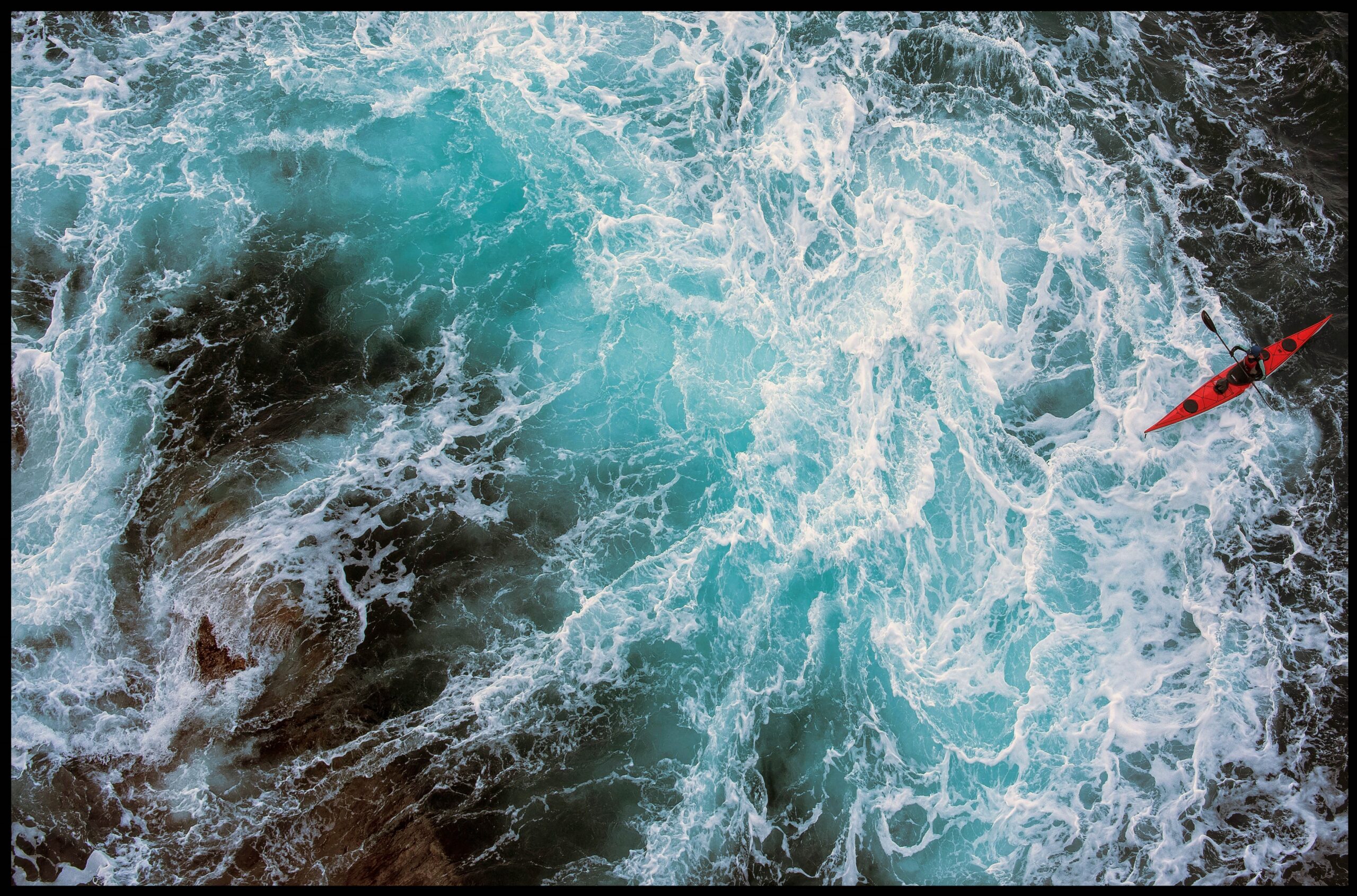
Most kinds of sea travel leave limited historical records. Small rowed and paddled boats have always vastly outnumbered sailing ships. In Ireland in 1836 (the first date we have figures for), 73% of boats were little open rowing boats and only 2% decked sailing ships. But big sailing ships were fully integrated into formal markets, where small boats often weren’t, so almost all surviving records relate to the 2%. Experience can help fill that gap. The craft of traditional boatbuilding is a form of historical research. So is sea travel. This photo was taken at the Stags of Broadhaven, 7km off the West coast of Ireland, on the day a storm blew in off the Atlantic. It shows the ability of a kayak to get to places, and gain perspectives, that large boats can’t. Many such places were travelled by countless families in earlier centuries.
The Journey
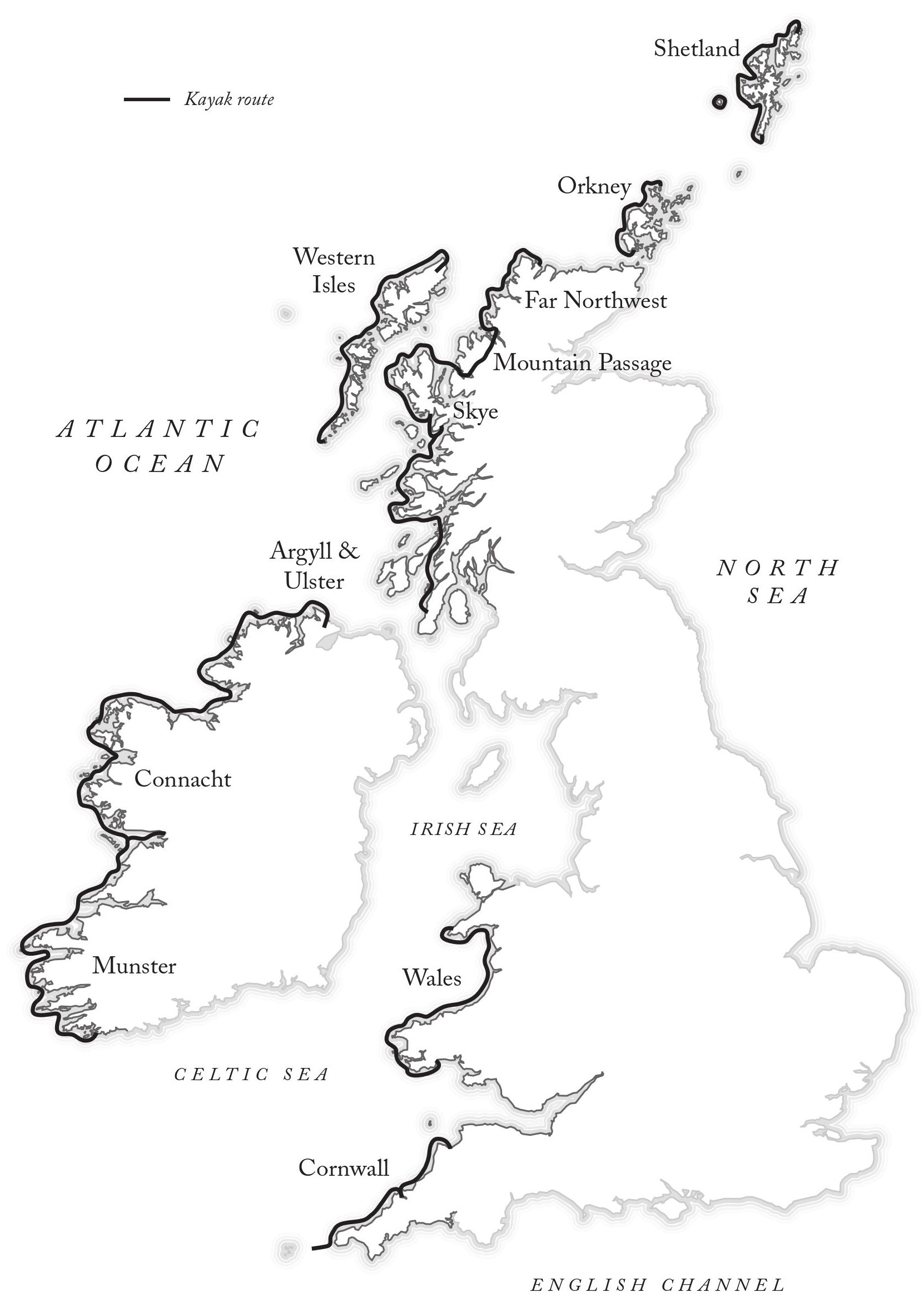
I used the kayak to seek a perspective from the water that might make Britain and Ireland unfamiliar. There were twelve legs of the journey (each done over two weeks of a month). Seven were in Scotland and only one (the very last) touched England at all. Coastal towns or leisure beaches were barely a feature. I’d travelled for five months before I reached my second town of more than 600 people. Only after ten months did I reach the first commercialised beach. And a very large proportion of the journey was through regions where English wasn’t the predominant language. Whether Shaetlan, Gaelic, Irish or Welsh, the languages of the coastlines have perspectives on water that can be richer than those of standard English.
The Skies
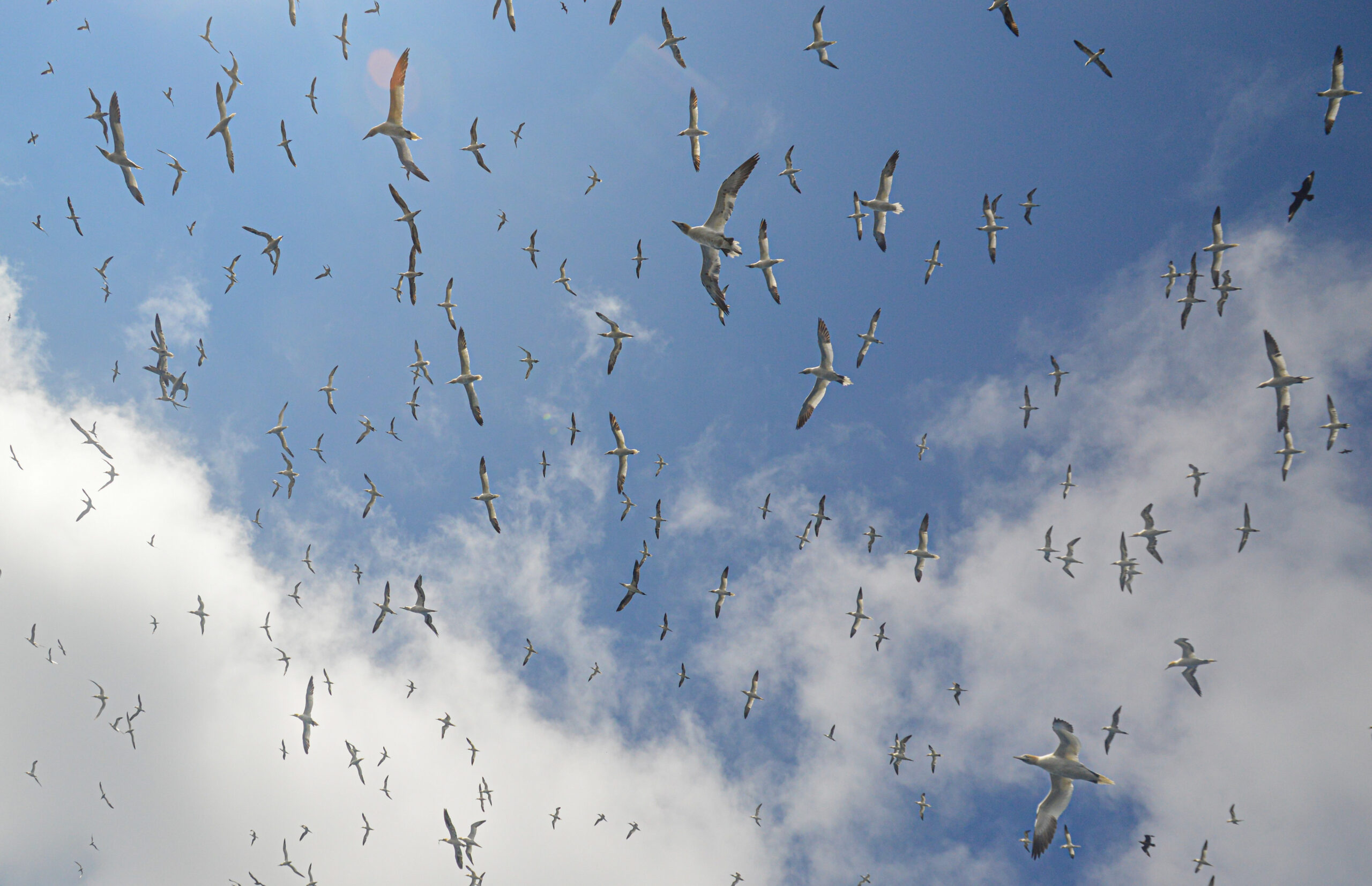
Our society isn’t good at representing or imagining the shore, especially its vertical aspects. Land maps (whether road atlases or Ordnance Survey sheets) leave the sea blank, while sea maps (such as admiralty charts) leave the land empty. The strange result is that everything that takes place across the shoreline is unmappable. And because so much coast is precipitous cliff, the bird’s-eye perspective of our maps hides large areas which have often been culturally significant. The visionary cartographer, Tim Robinson, draws his maps deliberately wrong to deal with this. He stretches coasts that would otherwise be thin lines into wider spaces, and covers them in names for sites that were once workplaces. That cliffs were once workplaces strikes many people today as strange. But being in a kayak beneath the immense clamour of thousands of birds, like these gannets, illustrates the phenomenal resource that the verticality of the coastline represented to societies where feathers, eggs and meat meant survival.
Setting Out
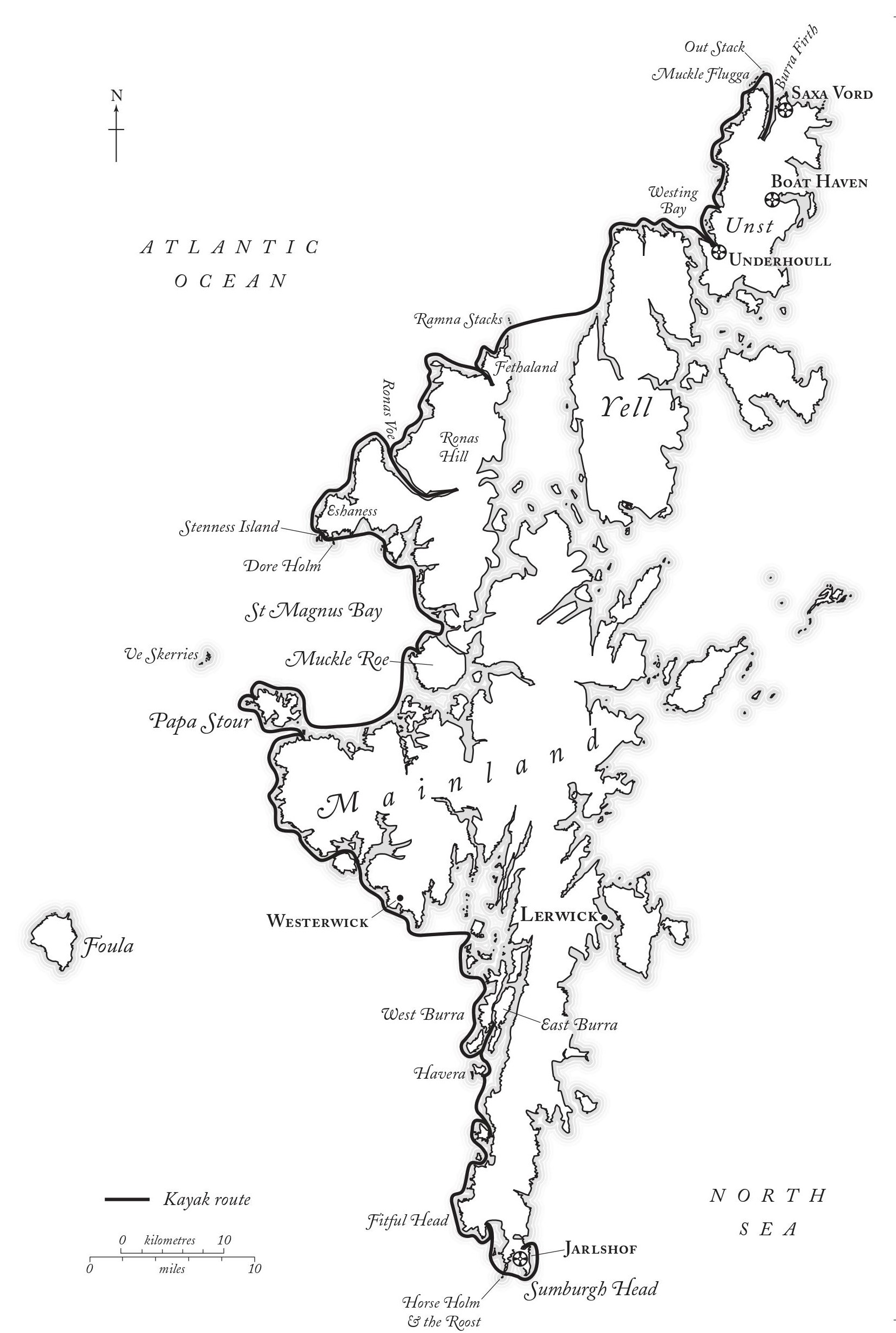
Shetland was the perfect place to begin, because it’s the region of the British Isles where the view from the sea is still best understood. Poets such as Roseanne Watt, Jen Hadfield, Jim Mainland and Donald Murray explore the intertwining of the islands’ maritime and linguistic heritage. The Shetland language, Norn, was wiped out in the eighteenth century, and in its place there emerged a rich dialect. This was strongest (and preserved most features from the old Norn) among the communities who worked the deep sea – the haaf – in tiny boats. The ‘haaf language’, as it’s known, has great prestige in the islands, in ways that give the impression that the heart of Shetland culture exists offshore. The historian Brian Smith says that by 1800 the Shetland dialect had taken its modern form, but ‘naturally, the vocabulary is now different, since we live in a society where dozens of words for small-boat equipment or seaweed, are unnecessary’. I wonder whether, if we’re to really understand the British and Irish islands and the meanings of our coasts, we need those old vocabularies back.
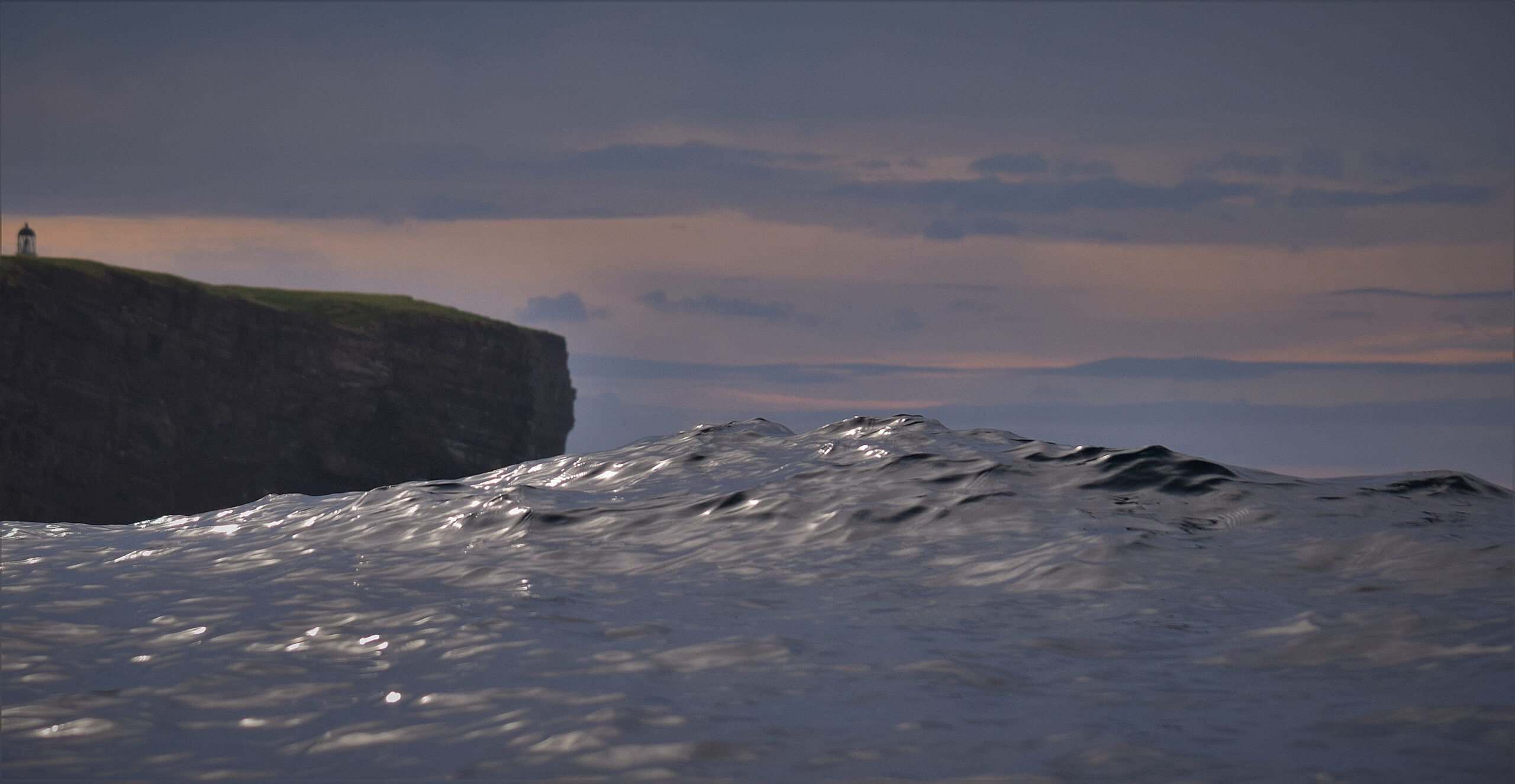
The Waves
Learning to navigate was an act of historical research itself, especially when travelling at night or in disorienting seas. Before this journey, I would have considered seas with messy swell to be like a closed door to me, but for this project had to reimagine them as highways. A rough sea is the most powerful force a person is likely to encounter in their life, so it’s impossible to work against. Learning to move with it, and use its movements for your benefit, is crucial. This is Birsay, at the western edge of Orkney, on a day of eccentric swell which, blended with unpredictable tides, meant weaving through the water as though through a maze. I remember thinking how inexplicable my movements must have been to anyone on shore, to whom the forces I was negotiating with might not be evident.
The Species
Rough seas are full of creatures. Sitting low in the waves, you can find yourself looking up at a whale, or passing through huge flocks of birds that had been hidden between swells. These are eider ducks, known in Scotland as dunters, and highly valued for their feathers. I passed through huge rafts of them at sunset on my way to the tiny Outer-Hebridean island of Pabbay, south of Barra. Like many West coast islands, Pabbay has only been unpopulated for a century or so, after a long history of supporting communities. In the nineteenth century, the occupants of Pabbay sent large quantities of feathers to Glasgow as the island’s main export. It always feels strange to recall, when seeing creatures like the dunters, that they were resources on which ways of life depended.


Tides & Breakers
There is now a long history of interesting thinking that comes from the water. It tends to have a political edge. In Scotland and Ireland, the clearances and famine often pushed communities off farmland and up against the coastline, meaning that coasts became sites of resistance. The great Gaelic poet Somhairle MacGill-Eain made sea cliffs into anti-fascist symbols. And many writers have recognised that tides, currents and waves link many parts of the world that have been artificially divided by national borders drawn on land. After the second world war, anti-colonial movements argued that western thought had been obsessed with land and territory. They suggested that water – with its depth and flux, with tidal time that moved backwards as well as forwards – could generate an entirely different worldview.
One of the most significant bodies of philosophy of the twentieth century emerged from the Caribbean – through thinkers such as Edouard Glissant and Kamau Brathwaite – and it made the ocean into the foundation of decolonised thought. Today, a movement called hydrofeminism takes indigenous thought, feminist theory and ecological ideas to argue that water is the element that shows humans to be most connected with the natural world. We are all bodies of water. All these writers show that the act of seeing from the sea is as rich with the potential to unsettle and inspire us as is the ocean itself. Perhaps it’s time to get in a little boat.
What a wonderfully interesting read. The photos are beautiful. I would love to see more. Very inspiring.