
Written by Onyx Ocean in October/November 2024, edited by Jill Howitt January-March 2025

I was vaguely aware of Artlink and 87 Gallery in Hull thanks to Wolds Pride’s Instagram (which I haven’t been to yet but know about through one of my partners who is local to the area). One day I stumbled upon 87,quite literally, whilst walking and taking note of my new city. I had walked past it before, so I followed the gallery on Instagram and was drawn to a story shared about someone finding a modernist guide to walking the city which is stocked by the gallery. I am a big fan of art deco architecture thanks to my dad, so I was intrigued to see what the modernist guide to walking the city involved.
The art/walking guide to the city drew me in because it really synced up with what I was already excitedly learning about geopoetics, mythogeography, and psychogeography. After reading She is the Sea by Crab and Bee, I read more of Phil Smith and Helen Billinghurst’s work, which quickly became pivotal to a shift in my personal practice. At first, I was intrigued at how led by water their practices were.I read Sharing the Walk, and then delved deeper into Phil Smith’s work and read his pieces in Walking, Writing, and Performance – the Crab Walks, Crabwalking and Mythogeography, and Crab Steps Aside, which is how I began to learn about geopoetics, mythogeograpy and psychogeography.
Geopoetics is an interdisciplinary approach combining elements of geography, poetry, and philosophy to explore the relationship between places, landscapes, and human experience, coined by Kenneth White in 1979. Mythogeography is defined as a way of thinking about and visiting places where multiple meanings have been squeezed into a single, restricted meaning. It emphasizes the multiple nature of places and suggests different ways to celebrate express, and weave together the numerous meanings attached to place, and involves a disrupted walking strategy as coined by Wrights & Sites. Mythogeography makes walking into a site-specific performance and is rooted in the Situationist analysis of The Spectacle and the practice of the dérive. Psychogeography is a related term referring to the exploration of urban environments that emphasizes interpersonal connections to places and arbitrary routes and studies the effects of the environment on the emotions and behaviour of individuals. Psychogeography is explored through the dérive or drifting tactic. (This, simplified, can refer to how we may always walk certain routes to specific places and the reasons why – how we learned the route, things we notice or always know about our way…) The dérive, or drift, is an unplanned journey through a landscape, usually urban, in which people stop focusing on their everyday relations to their social environment. It is a mode of experimental behaviour linked to the conditions of urban society: a technique of rapid passage through varied ambiences. There are many different ways to intentionally engage with the dérive tactic, some include using a camera as an aid to exploration.
The exhibition that happened to be on when I visited 87 Gallery was Cold Junction by Luis and Sebastian Bustamante. I didn’t know anything about the Chilean refugees or history at all really, and even though I am white as can be, it was an amazing exhibition for me to see shortly after moving to my new city. It brought up lots of feelings for me, one of which was the feeling of coming to a place that feels welcoming and warm (despite the cold) after fleeing from elsewhere.
According to Facebook’s targeted ads, I am an expat, but in reality, I fled Trump’s America as a queer, disabled educator to “go back” to my dad’s country and find out what it means to me. Trump got elected on my 21st birthday, and less than a year later I was living in the UK where I am also a citizen. I fled in what felt like the easiest way for me – by going to university – which was perhaps the easiest way for the Bustamantes to flee their country as well. Though I’d lived in this country for seven years before coming to Hull, it felt like I was running again – this time from an unstable and unsafe living situation that my partner and I had been forced into by exploitative landlords and letting agencies who were taking advantage of vulnerable neuroqueer people and immigrants (not a problem solved by moving to a different city, but that is tangential). We fled from Plymouth, a lovely city that is becoming more and more gentrified, to go to a city that is (or feels) more working class and more grassroots/community organising/revolution friendly. Having been accepted for housing in this city, after barely being accepted for housing where we used to live, it feels like we have fled to somewhere more accepting too. Hearing what Luis said in the video about feeling like the people here were very warm it resonated with me and reflected back my experience. Like me, Luis struggled with the cold but felt the warmth of the North and said that it had been nice for them in exile to come to a welcoming place that felt chummy.
As someone who has always been interested in photography, though from an amateur perspective only, I was intrigued hearing Luis’ discussion of the magic and power of photography and the influence on his practice…
When he discussed walking and taking photos on the street, I was struck by connections to the research of Phil Smith and Helen Billinghurst (Crab and Bee) that I had recently been reading – about walking, mythogeography, psychogeography, geophilosophy, and geopoetics. As I mentioned previously, a camera can be used as an exploratory aid when engaging with the dérive tactic.
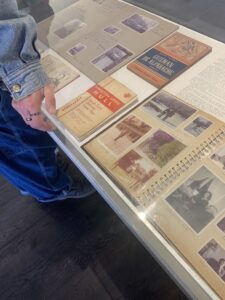
There were also some parallels with Sebastian’s mum’s scrapbook “how to spend your summer in Hull” and the hand drawn maps that she included. This relates to psychogeography, and at the time I was also drawing my own maps of the city – I was learning as I walked around it, developing my new psychogeography and geopoetics. All of these things make links to place based connections, which are additionally echoed when Seb talked about only knowing Hull from Luis’ photo and learning about it through the photos.
Seb also talked about not growing up in Chile and yet retaining a place-based connection to it because of his parents, which I related to with my father living in a country different to his country of birth for my whole life (even though he emigrated and wasn’t exiled).
Place based connections are the attachments that we can naturally form to specific places we have engaged with or existed within. Some place-based connections might just be the memory of a nice view you once saw, while other connections are more intimate, such as associations with childhood homes or neighbourhoods, regular places of learning or play such as schools, fields, and playgrounds, or frequent vacation spots. Yemini, Engel, and Simon (2022) point out that according to Waite (2013), “knowing” a place means expressing sensitivity to its complexity and being aware of the differences and similarities between that place and other places. They also acknowledge the phenomenon of disconnection from a place (“placelessness”) which stems from processes of globalisation and mobility, resulting in feeling more connected to places far away. (Kane et al., 2016). People may simultaneously feel alienated and disconnected from their community and place of residence (Gruenwald & Smith, 2014; Wattchow & Brown, 2011).
I operate from a very place-based praxis when I am educating, especially in outdoor education. The majority of my educating outdoors has happened within the contexts of beach and forest schools. According to my research, Robertson et al. (2009) provide the clearest indication of the potential forest schools hold to explore place. In the appendix the authors spend time writing about a ‘sense of place’ as ‘learning about and connecting with the local community, culture, history, work and use of local resources,’ (ibid. p. 42). They highlight the possibility for developing a local sense of place, urban or rural, using experiential and creative ways to develop connections, and the need for educators to engage in this process. (Harrison, S. 2011) Though I consider myself to be an outdoor educator, I am also critical of outdoor education and the forest school model. The problem that many outdoor and environmental education programs, organisations, researchers, and theorists are facing at present is that environment is seen as something out there, separate from us, which we go out into. So that problems are also ‘out there’ to be solved. Often the human cultural elements of places are obscured in favour of ‘nature’. This nature is global, the environment is generic, or at best divided into ecosystems, rather than distinctive and local. Furthermore, the learner is often profoundly displaced from home and everyday ways of being. Additionally, despite tidal, or geological knowledge, many outdoor practitioners neglect the local place-names, stories or distinctive features of the venues they use. (Harrison, S., 2011). The problem here is that ‘environment’ in UK environmental education is not a place through which we live, but an external concept explored by the use of different techniques in different venues” (Harrison, S., 2011). I was trained with the underlying assumption that place-based education involves directly interacting with ‘place’ which will foster an appreciation of, and an ethic of caring for, the land and its inhabitants (in every sense of the word). Outdoor learning can become a meaningful part of pupils’ lives by being rooted within a familiar socio-cultural context (Beames et al., 2009, p. 39). Place-based education and place-based connections encourage us to explore being part of nature and not considering ourselves separate to it.
I believe that it is important to understand how educational experiences can explore place, and the role these experiences can play in education. ‘Place, rather than environment or adventure, is the explicit aim’ (Harrison, S., 2011). We can learn practical ways to educate in place and philosophical questions of how we explore place as our way of being. According to Yemini, Engel, and Simon, place-based education prioritises experiential, community-based, and contextual learning in order to inculcate students with a sense of civic identity and engagement. This is achieved by cultivating connections to community and prioritising decisions for the common good over the individual (2022). They also state that ‘the priorities of place-based education generally centre around active learning, modalities to create a greater attachment to local community and context, while allowing students to become proactive investigators of the multiple environments – cultural, ecological, social, political, economic – in which they both learn and live.’ Place-based education strives to ‘build connections using community processes and community-based education (Jennings et al., 2005; Sala, 2007). With this emphasis, place-based education embraces a kind of citizenship or civic modality whereby students are able to identify and then act on issues in their local areas (Smith & Sobel, 2010). These often include a strong environmental focus, whereby place based education is emphasised as a way to foster ‘environmental citizens’ (Schild, 2016 cited by Yemeni, Engel, and Simon, 2022). A place-based practice is thought to encourage the formation of place based connections.
Place-based connections are considered important in the realm of outdoor education because of the way that they can anchor people in their understanding of the world and because attachments to place can influence people to make decisions based on the continued desire to engage with the place (for example – regular litter picking on a favourite beach). I had been feeling a lack of confidence in my practice after moving to my new city, but seeing Cold Junction at the same time as I was engaging with Phil Smith’s work on psychogeography helped to revive the spark in my heart and remind me of one of the pillars of my pedagogy – the power of place.
Ultimately, I loved how this exhibition gave me an intimate glimpse into specific people’s lives as well as a perspective on everyday life in the 1970s in my new city. I came across scenes I recognised, reflecting things back to me I’d recently learnt, and helping me to solidify some place-based connections with my new home. The exhibition also gave me hope that I have perhaps moved to a good place for me.
I got myself out of Trump’s America to flee the conservative view of me as a queer educator, and because I knew he did not care in any useful way about education or disabled people. I did not move to a less conservative country. Currently out of my field of work because of who I am [Queer/chronically ill/disruptive], all I knew how to do was move where I could be with people who love me and make me feel safe, and this is where they were going to be. Cold Junction reminded me of what I thought when I first came to visit the city and watched a film at the Streetlife Museum – that maybe it wouldn’t be a bad place for me.
I would never have discovered Cold Junction if I hadn’t seen @artlink_hull reshare someone’s post about finding the modernist guide to walking the city at 87 Gallery, and if I hadn’t wanted to get a copy, I would also not have come across the Blue Green Zine by the Critical Fish – something else giving me hope that perhaps I am in the right city at the right time to form new place based connections and help remind others of the ones they have created themselves.
Works Cited
Billinghurst, H. and Smith, P. (2021) Sharing the Walk https://www.academia.edu/51279847/Sharing_The_Walk
Crab & Bee (2019) She is the Sea Triarchy Press
Gallery 87 (2024) 87 Studio: Luis and Sebastian Bustamante – COLD JUNCTION https://youtu.be/lO55yQ7Uglo?si=CfwYUZFK4tXxo0kQ
Harrison, S. (2011) Place-based praxis: exploring place-based education and the philosophy of place https://www.academia.edu/114731944/Place_based_praxis_exploring_place_based_education_and_the_philosophy_of_place
Mythogeography (2015) Not Psychogeography https://www.mythogeography.com/not-psychogeography.html
Smith, P. et al (2009) Walking, Writing, and Performance https://www.academia.edu/209075/Walking_Writing_and_Performance
Yemini et al. (2022) Place-based education – a systematic review of literature https://www.tandfonline.com/doi/full/10.1080/00131911.2023.2177260

by Onyx Ocean
Youth Outreach Officer
Onyx is a multidisciplinary practitioner whose areas of interest are art, education, flow, movement, nature, and place-based connections.
Thanks for a great and illuminating article. There’s a lot to chew there, but I was thinking of how photography can so intensely record so many of the things you talk about. Makes me think how much deeper I could have delved into the city’s character if I managed these concepts you talk about. Those photos were more about daring to connect and it was sheer luck that I just couldn’t stop walking the streets (as I still do these days). It was the vision of Tom White, the curator, the obsessive dedication of the staff at 87 Gallery and the persistence of my son Sebas that turned the work into an object of collective benefit.